
The Foundation Is in Place
Over the past months, European Engineers United (EEU) has been working on the technical foundation of the EEU Roadmap, a platform designed to capture, structure, and connect Europe’s technological future.
Today, we are pleased to announce an important milestone:
The core architecture of the EEU Roadmap is now operational.
From Ideas to a Structured Knowledge Graph
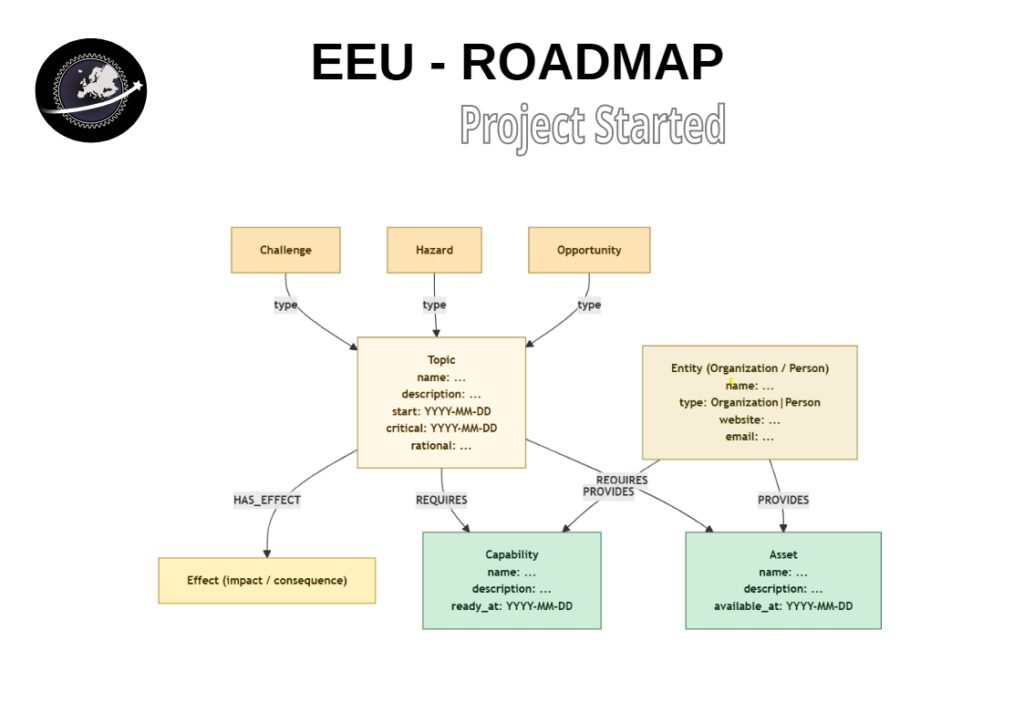
The EEU Roadmap is built around a connected data model rather than traditional documents, spreadsheets, or presentations.
The platform currently supports the following object types:
- Categories
- Topics
- Capabilities
- Assets
- Entities
- Effects
Relationships can be defined between all objects, allowing technology domains, required skills, infrastructure, organizations, opportunities, and risks to be linked together in a meaningful way.
This approach transforms isolated information into a growing network of knowledge that can be explored, analyzed, and continuously expanded.
A High-Performance Graph Database at the Core
At the heart of the platform is a high-performance graph database.
Every object is stored as a node, while all relationships are represented as graph connections. This allows highly interconnected information to be managed and analyzed far more efficiently than with traditional relational databases.
The graph architecture provides the basis for future capabilities such as:
- Technology dependency analysis
- Capability gap identification
- Risk and opportunity assessment
- Organizational ecosystem mapping
- Strategic technology planning
- Impact analysis across multiple domains
Our long-term vision is to build a European Technology Knowledge Graph that helps engineers, researchers, innovators, and decision-makers better understand technological developments and their dependencies.
Interactive Timeline Already Available
One of the first major features is the interactive Timeline View.
Topics, capabilities, and assets can already be positioned along a timeline, enabling users to visualize technological developments over multiple years and understand critical dependencies between different activities and technologies.
EEU Roadmap Timeline
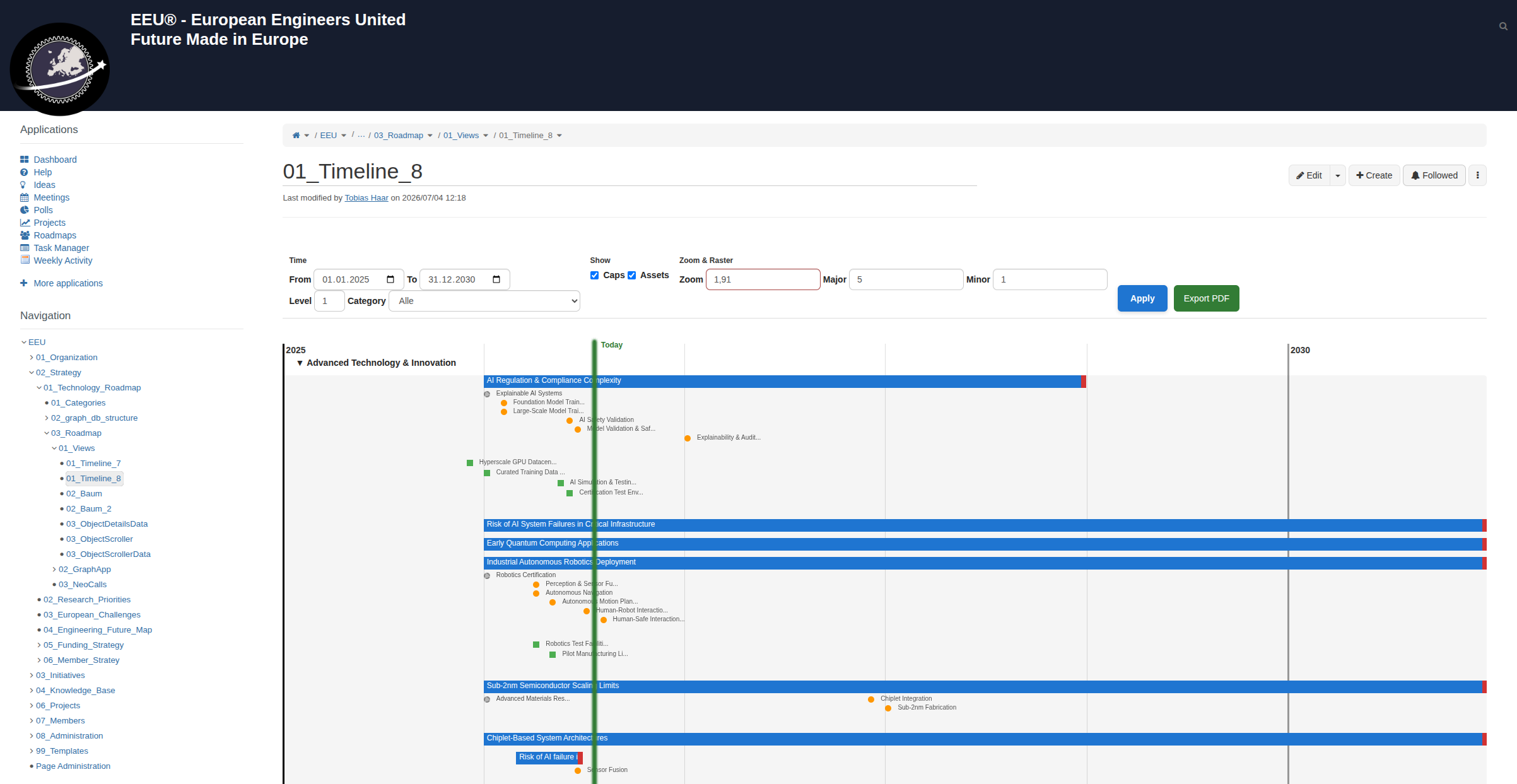
The Timeline View allows users to:
- Navigate through long-term technology roadmaps
- Zoom into specific periods
- Visualize dependencies and milestones
- Explore relationships between technologies, capabilities, and supporting assets
This creates a dynamic overview of how future technologies may evolve and what prerequisites are required along the way.
Exploring the Knowledge Graph
In addition to the timeline, the platform already provides a graphical navigation interface called the Object Scroller.
EEU Roadmap Object Scroller
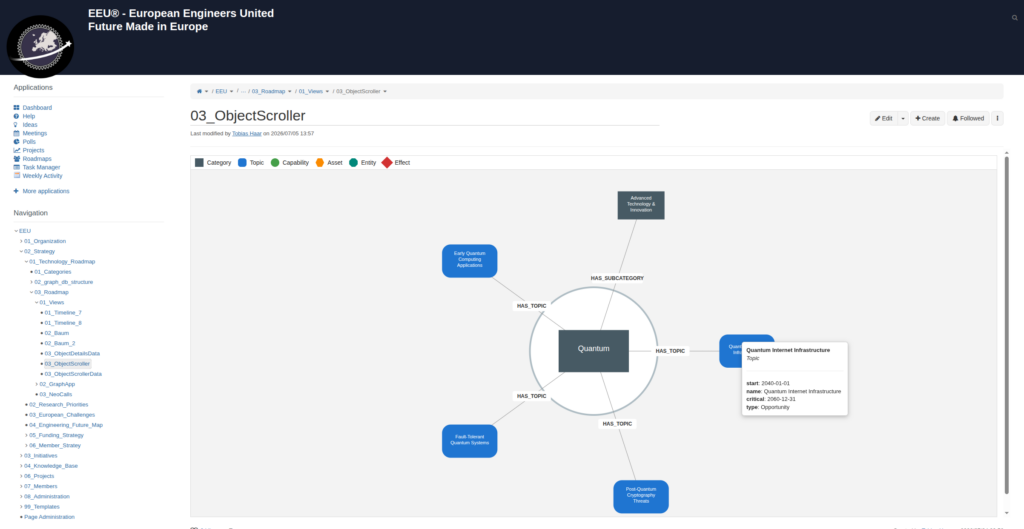
The Object Scroller allows users to navigate through connected objects and instantly understand their relationships.
Users can explore:
- Categories and subcategories
- Technology topics
- Required capabilities
- Assets and infrastructure
Organizations and entities - Opportunities, risks, and effects
Instead of browsing lists or spreadsheets, users can move directly through the knowledge graph and discover how technologies, organizations, and capabilities are connected.
Current Focus: Capturing and Structuring Data
With the technical foundation now established, the next major phase is the systematic collection and structuring of data.
Collecting information is only part of the challenge. Ensuring long-term consistency, quality, and maintainability is equally important.
Many knowledge platforms eventually suffer from:
- Duplicate information
- Inconsistent terminology
- Isolated datasets
- Outdated content
- “Data graves” that are no longer maintained or used
The EEU Roadmap is being designed from the beginning to avoid these problems.
Alignment with European Standards
To ensure long-term sustainability and interoperability, the EEU Roadmap will align its data model with established European standards wherever possible.
ESCO for Capabilities and Skills
Capabilities and skills will be aligned with ESCO (European Skills, Competences, Qualifications and Occupations), providing a common European vocabulary for competencies and expertise.
ECLASS for Assets and Services
Assets, technologies, products, infrastructure, and services will be mapped to ECLASS, enabling standardized classification across industries.
We are currently investigating licensing options and whether access can be obtained free of charge or at reduced cost for non-profit organizations. The standard license currently costs approximately €700.
CORDIS for Entity Verification
Organizations, research institutions, and companies will be linked to European research and innovation databases such as CORDIS whenever appropriate.
This will help verify entities and connect roadmap topics to existing European research activities and innovation programs.
By building on existing European standards, we aim to create a roadmap database that remains consistent, searchable, and maintainable as it grows.
Building a European Technology Knowledge Graph
The EEU Roadmap is evolving beyond a traditional roadmap.
Our objective is to create a living knowledge graph that connects:
- Technologies
- Skills
- Organizations
- Infrastructure
- Opportunities
- Risks
- Societal impacts
- Economic effects
As the dataset grows, every new node and every new relationship increases the value of the entire network.
The result will not simply be a collection of technology forecasts, but a structured representation of how Europe’s future technologies, capabilities, and organizations interact.
Join the Effort
The architecture is in place.
The graph database is operational. The core data model has been implemented. Timeline visualization is available. Graph navigation is functional.
Now comes the most important phase:
Building the knowledge base itself.
We are looking for engineers, researchers, scientists, entrepreneurs, students, and technology enthusiasts who want to help map Europe’s technological future.
You can contribute by:
- Adding technology topics
- Identifying critical capabilities and skills
- Mapping important assets and infrastructure
- Connecting organizations and research institutions
- Contributing expert knowledge
- Improving the EEU platform and data model
- Participating in discussions about Europe’s future priorities
Every contribution makes the roadmap more valuable for the entire community.
Our vision is ambitious:
To create an open, structured, and continuously evolving European Technology Knowledge Graph that supports collaboration, innovation, and strategic thinking across Europe.
The EEU Roadmap is not designed to ask what Europe should copy from others. It is designed to ask what Europe should build for itself.
Become a Member
If you would like to contribute to the initiative and join the EEU community, we invite you to apply for membership.
Together, we can build the roadmap that helps shape Europe’s technological future.
Future Made in Europe.
European Engineers United (EEU)
Building Europe’s Technology Roadmap Together